

 All articles
The OS Reality
To begin: every company has an operating system, whether they realize it or not — even yours.
Whether written in stone or referenced once a quarter during executive planning. Whether instilled through formal training or through the unconscious habits and biases of specific leaders.
Good or bad. Healthy or toxic. Strategic or reactionary. Every company has one, including yours, and it’s either helping you grow or holding you back.
Because an operating system is simply this: the mechanisms behind your performance.
From standard meeting formats to the management style of top executives. Whatever set of tools, processes, values, and beliefs influence the daily behavior of your employees — that’s your operating system.
For companies in essential industries, where complex projects carry razor thin margins for error, a strong operating system is the single most important opportunity to stand out.
And as we’ll explain in this article, companies that use their brand as their OS itself create an even greater advantage over their competitors.
The Brand / OS Relationship
You might be asking what your brand has to do with your company’s operations. Or to put a finer point on a common question — what does your logo, for example, have to do with your crew’s productivity out in the field?
If so, you’re not the only one. But the question is flawed in two important ways. The first is a matter of terminology. Specifically, how we define “brand.”
In the essential industries especially, a brand has traditionally been viewed as a logo: the mark customers see on equipment, trucks, and the sign in front of the main office. If that were as far as it went, then of course your “brand,” as it were, would have zero impact on performance in the field.
But the truth is that what we call “brand” has never been about just a logo.
Clients of FieldWrk who have been through our branding process will have heard us say often: your brand is formed by two parts, your identity as a company and your reputation. In other words, what you say about yourself and what others say about you.
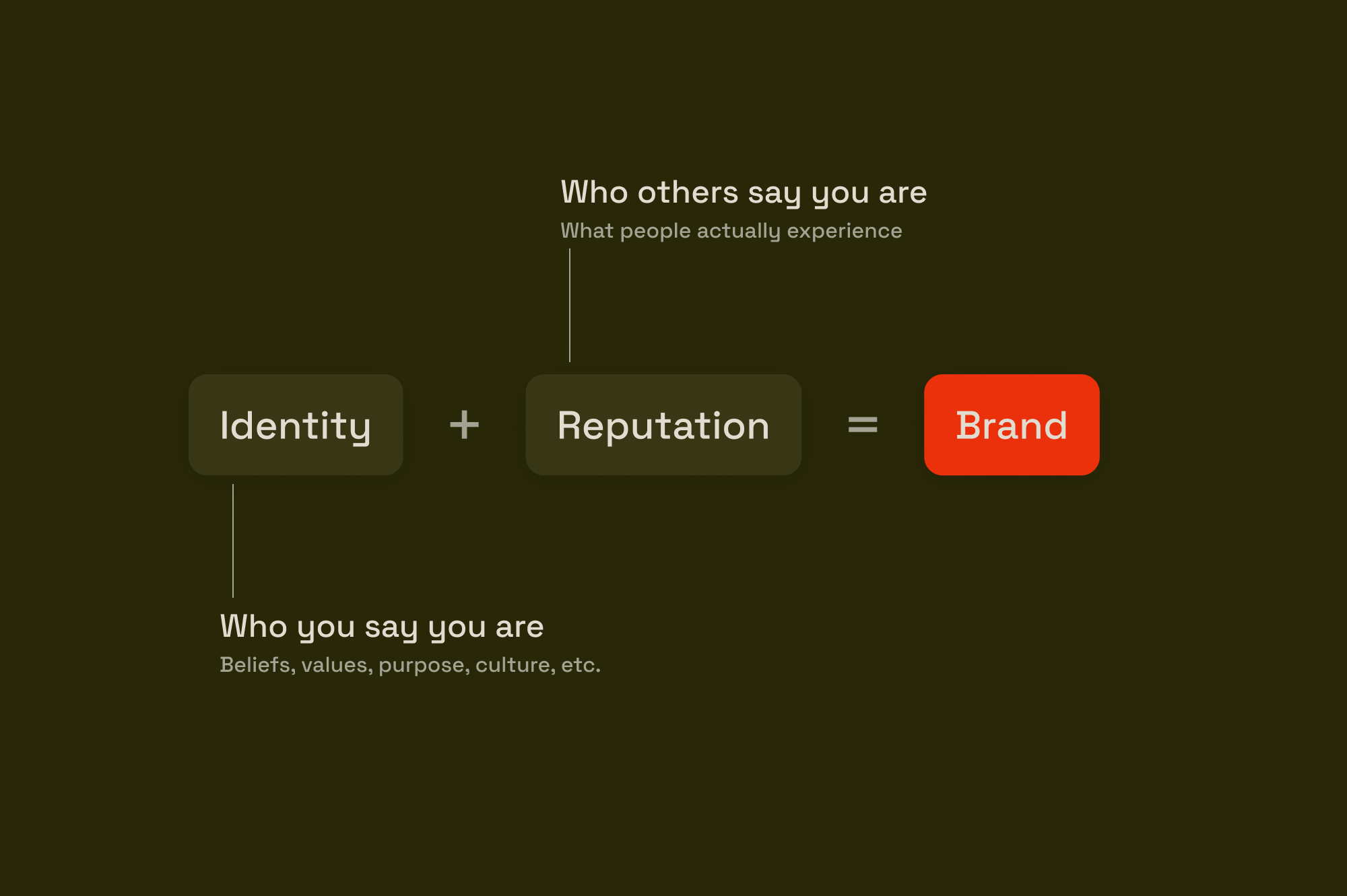
But there is another, less often discussed factor in this equation, which is how a company operates. This is the second flaw in the question, “What does my brand have to do with my company’s operations?”
The short answer is everything, because how you operate is your identity. In the words of Aristotle, “We are what we repeatedly do.” The trap many infrastructure leaders fall into is viewing brand and operations as separate entities, instead of parts of a whole. Because a company can claim all kinds of things about itself, but if its operations don’t back them up, then customers won’t buy into them.
To put it another way: if your brand isn’t helping you operate better, it’s just writing on the wall.
A brand identity must include what an organization believes, promises, prioritizes, values, and DOES. Those factors absolutely influence how a company operates.
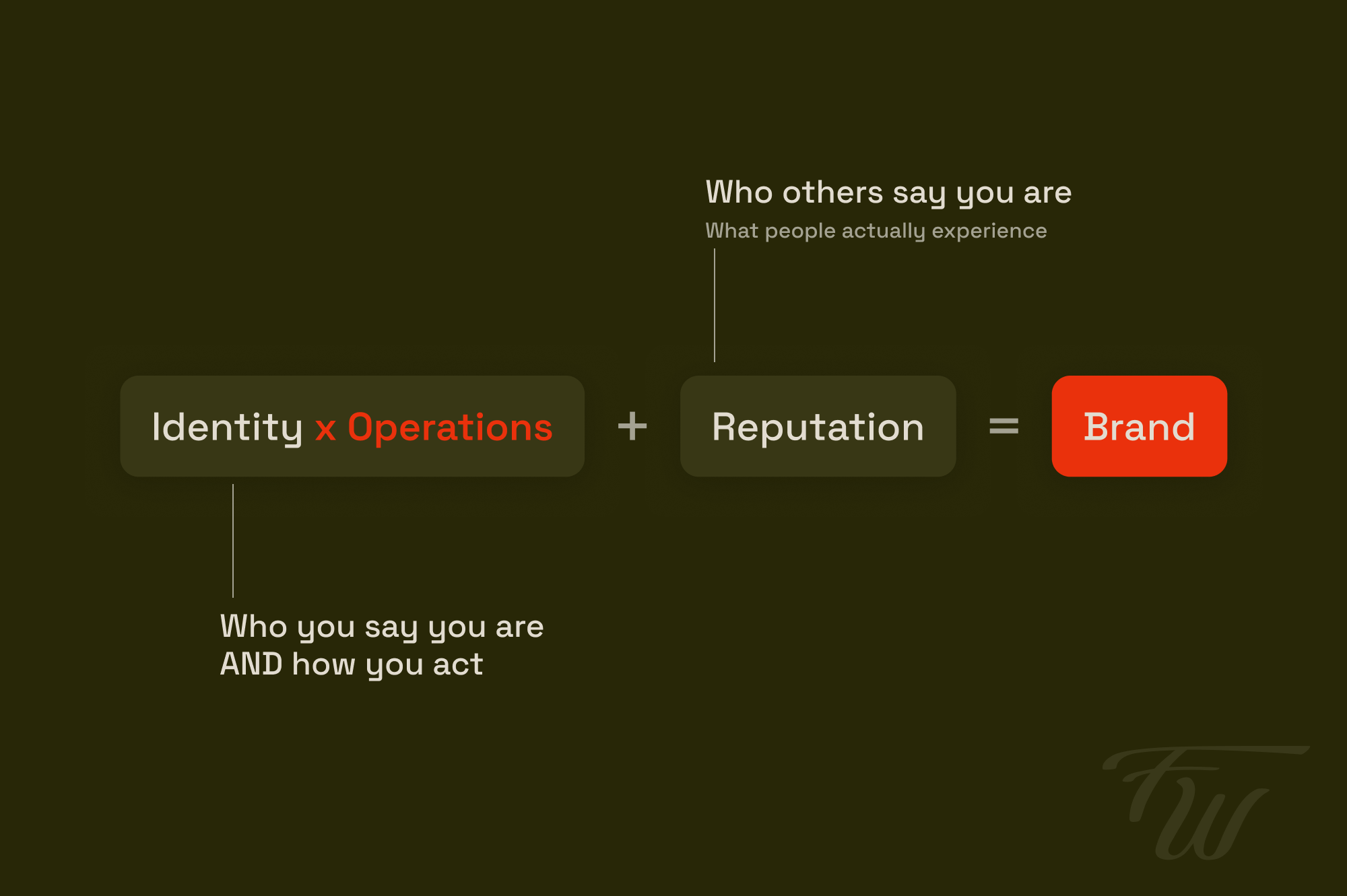
When a company views their brand as an operating system, it becomes a force multiplier for their business.
The Brand / OS Gap
The strength of any brand is largely determined by whether its identity (who the company claims to be) aligns with its operations. Most business owners understand this intuitively, even if they’ve never thought about it in precisely these terms. At its core, the equation is simple:
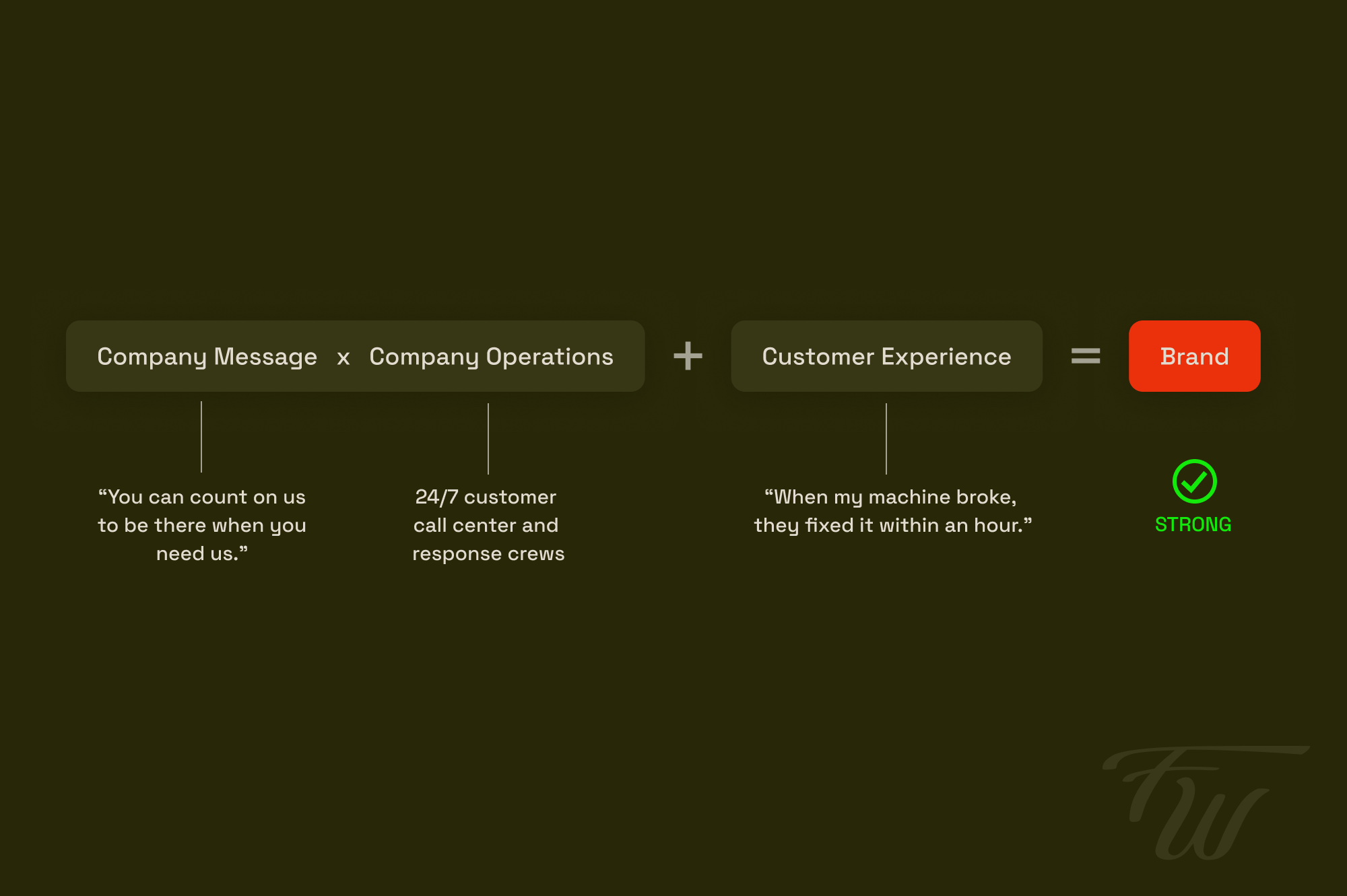
Often when we see brands struggle, it’s because they’re describing themselves one way but operating in another.
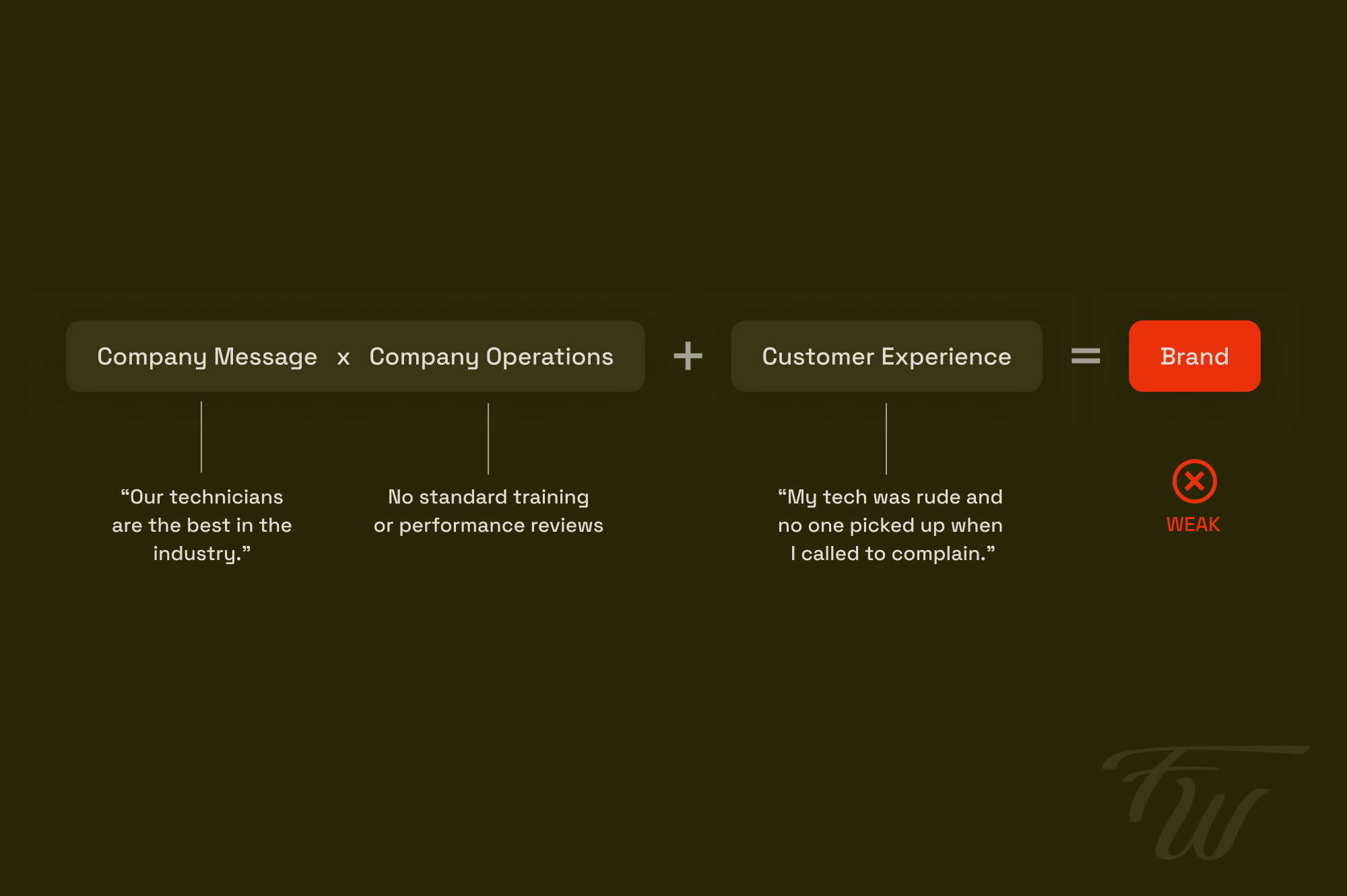
The gap between what your company says and does isn’t a cultural problem, it’s a brand problem. Your brand isn’t being treated as a true operating system.
How often have you seen companies in essential industries adopt mission statements that speak to “serving the industry” or a “commitment to delivering projects on time and within budget?” Or seen companies with values along the lines of “integrity,” “excellence,” and quality?”
Beyond the use of cliche phrases and abstract ideas, the issue with those kinds of brand identities — which for decades have been the norm in essential industries — is they’re not actionable. They don’t guide or inform operations in any meaningful way.
This creates a disconnect, or gap, between a company’s brand and its operating system, which risks delivering a service or experience that falls short of customer expectations.
And nobody wants that, especially not you.
Brand / OS Alignment
To function as an operating system, your brand must first be actionable. Meaning it must connect to employee behavior.
A brand belief that doesn’t influence how people work isn’t a belief, it’s a talking point.
Take one of our industry’s most common phrases, “Safety First.” It’s ubiquitous. Virtually every construction and infrastructure company says it, and many include it as part of their brand identity. But what does it mean in practice? How is it applied?
More importantly, does it influence how supervisors are evaluated? How new employees are onboarded? How production schedules are managed? In short, does it drive behavior across a company’s operations?
There’s no reason it can’t, but the strongest brands are specific about how they operate.
For comparison, Casella’s internal safety brand, The Power of Safe Work, pushes beyond industry cliches like “Safety First” to outline preventative safety frameworks (See it. Stop it. Save it.) safety standards (Zero Shortcuts. Zero Incidents. Zero Excuses.) and beliefs (Safe work gets us home.)
These branded components have become part of Casella’s identity and operating system, resulting in strong brand / OS alignment.
The same principle applies to any component of your brand. If you say you’re customer- focused, that should influence how your teams communicate and respond to requests. If you say your company is innovative, it should be obvious to your customers in how your teams approach technology, processes, and creative problem solving. If you say you care about people, it must be abundantly clear in how you hire, train, and develop your team.
The point here is not to turn every company belief or value into a corporate policy (please don’t do that) it’s to create a clear set of principles for decision-making.
It’s to bridge the gap between who you say you are and how you operate — Brand / OS alignment.
Strong brands give teams a common language. When that language is clear, specific, and actionable, it can transform operations across an entire organization.
The Human Element
In this era of AI, we talk a lot at FieldWrk about the human element. And this is especially relevant when considering a brand as an operating system.
Companies, most of them, aren’t run by machines. Certainly not in the essential industries we serve. They’re run by people.
Good leaders know that people don’t perform at their best when they’re simply handed a set of processes. It takes more, something deeper. The reality is that most infrastructure jobs are tough, physically demanding, and underappreciated in society. To bring out the best in your teams, you must give them a reason to care and be proud of what they do. A vision to work toward. A purpose to rally behind.
That’s the human element of any brand, and the reason yours must not only be clear, but motivating as well.
Strong brands give people something to believe in and a shared understanding of what an organization stands for. They inspire employees to want to perform at their best, to work together and operate at the highest level, even when no manager is present.
This matters even more in companies made up of hundreds or thousands of employees, where continuous oversight simply isn’t possible. As leaders, you can’t supervise every moment on a project, but you can give your people a clear set of beliefs and principles to carry with them.
That’s the true power of a strong brand operating system: it scales leadership.
How An Agency Can Help
If this all sounds great but overwhelming, a strategic brand partner like FieldWrk can help tackle the challenge of building a brand OS.
Over the years and through hundreds of brand projects, we’ve refined our brand delivery method to craft brands that drive measurable impact on operational performance. We dig deep into understanding our clients’ goals and challenges, and translate insights from the executive level into brand foundations for long-term growth.
But whether you partner with FIeldWrk or another agency, the advantage comes from the perspective of someone outside of your organization looking in. An agency can serve as an objective third party to help clarify ideas, keep brand identity elements actionable, and implement the systems that will transform your operations — if they know their stuff.
Build a Brand that Works
Every company has an operating system, even yours. If your operations aren’t living up to the promises your brand is making to customers, the problem isn’t that you lack an OS. It’s that your existing OS — whatever tools, methods, values, and beliefs that define who you are, whether you realize it or not — doesn’t align with who you want to be as a company.
Brands That Wrk are consistent across their identity, operations, and reputation. If you’re interested in taking the first step, let’s talk.