


 All articles
Over the past 7 years and 100+ strategic brand culture workshops, we’ve had the privilege of partnering with some of the best, high-performing infrastructure organizations in the country, and the leadership teams behind them.
While they’re each distinct, every high-performing organization shares some consistent qualities. Their field and office teams are caring, engaged, and accountable. The company has a clear mission. Its people work together to accomplish that mission. And the company’s bottom line and overall performance benefit as a result. These are the organizations that often command a premium in their pricing models, as well as in the talent they attract.
Successful infrastructure leaders understand that their competitors generally have access to the same equipment, technology, and materials. But you can have access to all these and still not be successful.
Ultimately, it’s up to company leaders to decide if they are going to invest in culture and brand as an operational and competitive advantage — or let it exist as a disadvantage.
The best infrastructure leaders realize that leadership, culture, and brand are the true differentiators and competitive levers to pull.
Culture starts with leadership’s vision and beliefs.
Like most things in business, culture starts and ends at the top.
When a leadership team has a clear vision, a strong personal compass to guide them, and continuous accountability for themselves and their team, then it filters down through the ranks. Teams are able to move faster and make decisions because they know the mission and can make decisions in a decentralized command structure (nod to Jocko and Echelon Front).
A sign of a strong leadership and brand culture is when teams are empowered to and effectively execute decisions in a decentralized way.
A strong vision and value-set driven by leadership creates organizational focus and clarity. This is more critical now than ever before since we live in a business world of endless distractions, competing priorities, shiny objects, and potential opportunities. This affects not just day-to-day priorities (what do I need to work on today?), but also organizational priorities (what strategic initiatives do we need to invest in?).
The best infrastructure leaders recognize that their culture and brand are inherently connected, and that leadership is the biggest driver of both. When executive leaders are bought-in and engaged, then unsurprisingly, so are all their teams downstream.
The framework looks like this:
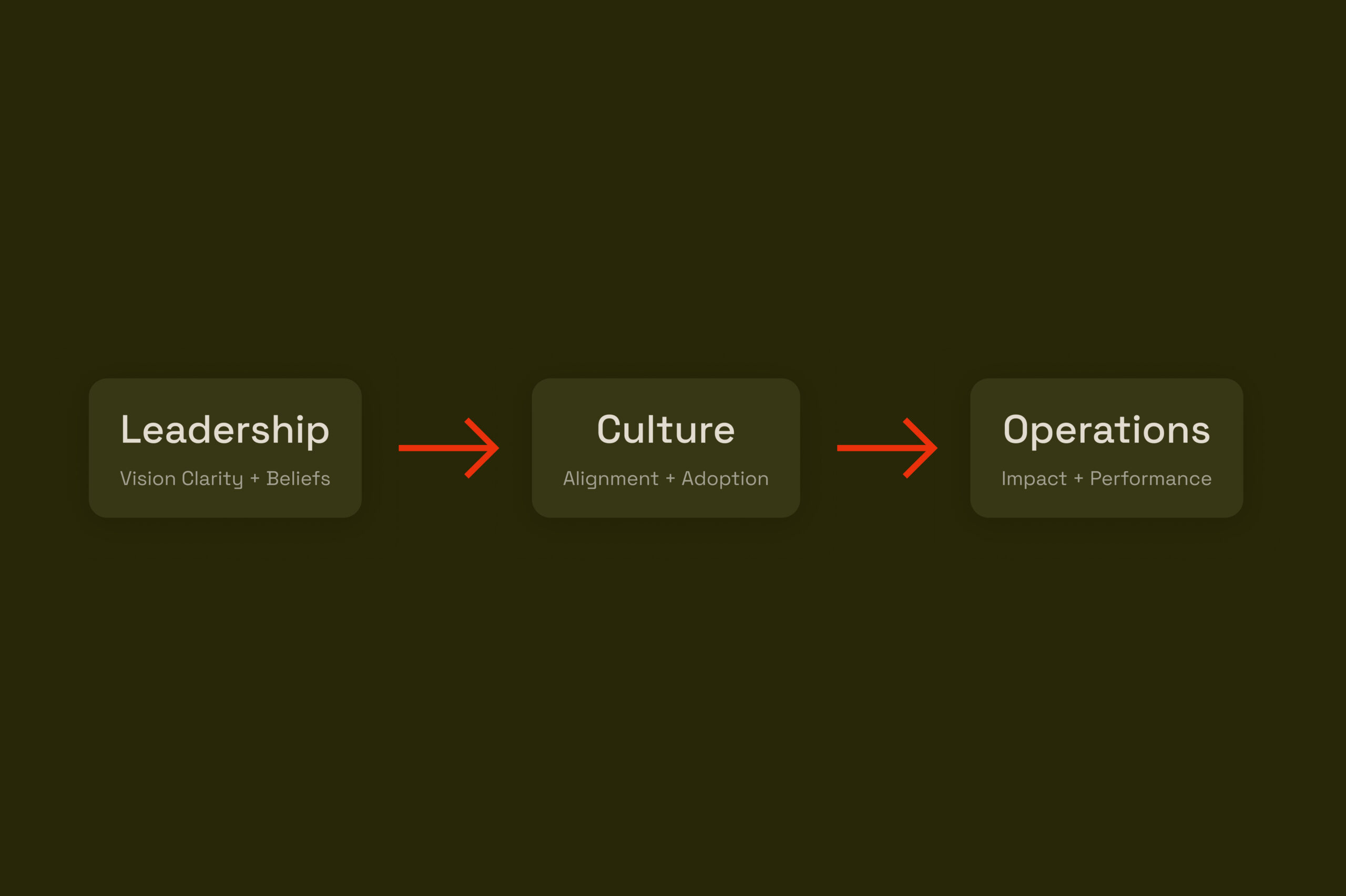
(Easier said than done, though).
Clarifying your leadership compass + vision
If you, as a leader, don’t know what you value most or can’t articulate the larger vision or mission to your teams, then how do you expect them to embrace and carry them forward?
These are the essential questions we ask leaders during any culture or brand transformation project. We’ve found many leaders have never been asked these before:
- What guides your decision-making as a leader? What’s your compass?
- Why do you get up each morning? What’s your motivation?
- Where are you heading? What’s the impact you aim to make in the world?
- How does your team make decisions when you aren’t there?
- How do you know what’s most important when priorities compete?
- How do you protect and scale a culture when your team grows significantly in a short period of time?
- Is your company culture an advantage or disadvantage?
The answers to these questions form the foundation of your brand culture (vision, mission, values, cultural priorities, behaviors, etc.).
When cultural leadership lacks:
In the hundreds of discovery conversations we’ve had over the past few years with senior infrastructure leaders, we can pretty quickly recognize when cultural leadership and vision are lacking. They can’t answer the questions mentioned previously and/or their actions don’t align with their words.
One of the biggest signs is when we hear a lot of “thems” and blaming the culture downstream.
- “They are just here to collect a paycheck.”
- “They’ll jump to one of our competitors for a 50-cent raise.”
- “They just don’t get it.”
- “They [insert demographic] just don’t want to work hard or learn.”
The through line is that these are “us vs them” phrases that lack leadership ownership. And, just like good attitudes, bad ones trickle downstream too. As Jocko and Echelon Front best put it, “every problem is a leadership problem”.
The reality is that no amount of brand and culture investment will fix or cover up a disengaged leadership team with a lack of vision, values, and accountability.
It must be driven by executive leaders first. It’s not a quarterly rock that can be assigned to a new marketing intern. Because if leaders aren’t bought in, reinforcing what’s most important culturally, and holding people accountable (starting with themselves), it’s not really going to be part of their brand culture.
When cultural leadership is clear and strong:
The flip side is true when leadership, culture, and brand are strong. It becomes a moat for their business and a true competitive advantage.
A great example of this is ESS Companies (ESSC). Now well over $1.4B in revenue and 3,000+ employee-owners with significantly above-average growth in the past 2+ years since the brand was launched, ESSC is a masterclass on the power of a clear leadership vision, executive alignment on company culture, and investment in brand.
Tim Paulson (Co-CEO), Caitlyn Cook (EVP of Employee-Owner Experience), and the rest of the ESSC leadership team clarified this vision early on when building the ESSC brand. At the heart of it was their unwavering belief in the power of employee-ownership to transform lives and their 5Ps to guide their actions.
The biggest takeaway is that it’s not lip service. You know this if you’ve ever listened to Tim or Caitlyn talk about employee-ownership.
- Tim and the executive team spend time in the field
- They’ve crafted an executive role specifically responsible for EOX (Employee-Owner Experience), which Caitlyn sits in
- They invest heavily in internal team events and their annual Shareholder Week
- They incorporate their vision and ESOP throughout all internal and external communications.
- They use their brand as a tool to allow them to reinforce their vision, mission, and cultural priorities across all of their subsidiaries
Brand reinforces culture, and culture validates the brand.
Once leadership’s vision is clarified and articulated, your brand can then become a tool to reinforce cultural priorities and guide decision-making. Over time, culture then influences and validates the brand.
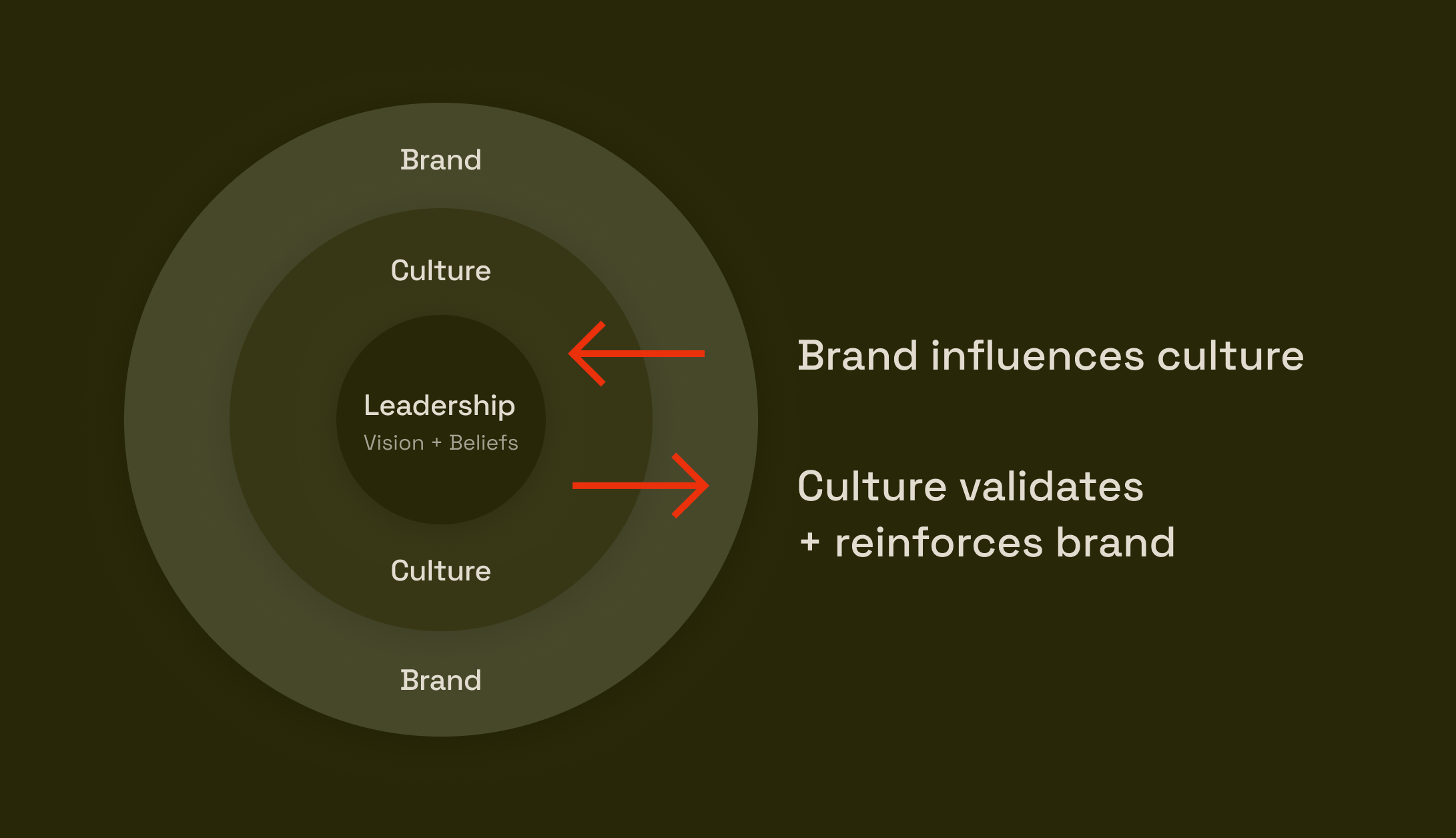
Brand and culture then become a reinforcing loop that strengthens the business and ultimately turns brand and culture into operational advantages. This is how your brand codifies and strengthens culture.
But remember, culture is driven by leadership. It must start at the top.
Read the Full ESSC Case Study Here